
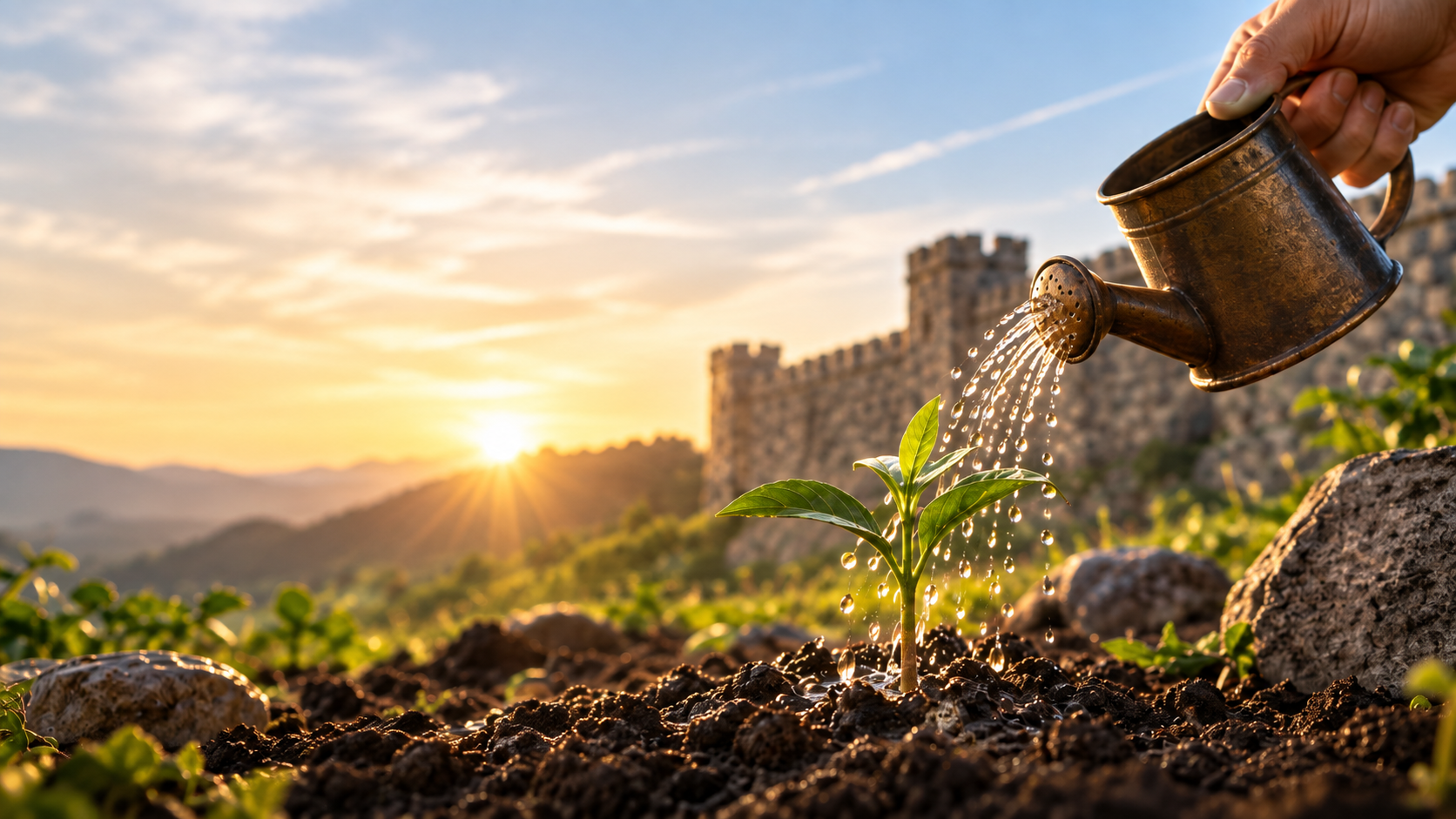
Recognizing a seed is only the beginning.
Once you realize that something matters, the next question is no longer What could this become someday? It becomes What does this need from me right now? That question shifts us from imagination into stewardship. It moves us away from fantasy and toward responsibility.
A seed may carry tremendous potential, but potential alone does not make it grow. It has to be tended.
That sounds obvious in a garden. If you plant something in the ground, you know it needs water, protection, attention, and time. You understand that growth is a process. You don’t stand over the soil demanding fruit by the end of the afternoon. You don’t accuse the seed of failure because it hasn’t produced a harvest in a week. You take care of what has been planted, and you allow growth to unfold in its proper season.
But in our own lives, we often relate to growth very differently.
We want clear results. We want reassurance. We want movement we can measure. We want to know that our effort is paying off. And when that payoff seems delayed, we start getting restless. We question the direction, the seed, the process, and sometimes even ourselves.
That is usually the moment we stop watering the seed and start trying to force the fruit.
Forcing the fruit can take many forms. It can look like rushing. It can look like trying to control every variable. It can look like bouncing between ideas because nothing feels fast enough. It can look like comparison, impatience, anxiety, or overcomplication. Sometimes it even looks like trying to manufacture an outcome before the root system is strong enough to support it.
But there is work that belongs to the farmer, and there is growth the farmer cannot command.
A farmer can prepare the soil, plant the seed, water it, protect it, and pull weeds. A farmer can be faithful to the process. But the farmer cannot order the crop to mature on demand. The farmer cannot skip the stages between seed and harvest. Growth happens in stages, and the work of care does not give us absolute control over timing.
That same principle applies to our lives.
There are things we can do. We can study. We can practice. We can write. We can pray. We can build. We can apologize. We can strengthen our routines. We can have the difficult conversation. We can make room for what matters. We can take the next wise step. These are forms of cultivation. They matter.
But they are not the same thing as controlling the outcome.
That distinction matters because when we confuse participation with control, we turn meaningful work into pressure. We begin demanding that our effort immediately prove itself. We measure everything by whether fruit is already visible. And when it isn’t, we become discouraged, distracted, or tempted to abandon what may actually need more faithful care.
Sometimes what a seed needs most is consistency.
Not intensity. Not drama. Not constant reinvention. Consistency.
A little reading every day. A page of notes. A conversation you’ve been avoiding. A practical budget review. A repeated skill practice. A healthier habit. A few quiet minutes of honest reflection. Often the next step is not glamorous. It is simply appropriate care for the stage you are in.
That is why one of the most helpful questions you can ask is this: What does this need from me right now?
Not forever. Not five years from now. Not after everything is perfect. Right now.
What does this relationship need? What does this calling need? What does this area of healing need? What does this habit need? What does this idea need? What does this part of the Fortress need from me right now?
That question has a way of calming the noise. It pulls you out of obsession with the final result and brings you back to the next responsible step.
Sometimes the answer is that something needs attention. Sometimes it needs protection. Sometimes it needs patience. Sometimes it needs less pressure and more room. Sometimes it needs a smaller commitment that you can actually keep. Sometimes it needs you to admit that the seed is real and deserves space in your life, even if you still don’t know what it will eventually become.
And sometimes what needs to be addressed is not the seed, but the pressure you are putting on it.
That pressure might come from comparison. It might come from fear that you are behind. It might come from a need to prove something. It might come from anxiety, insecurity, or the belief that if visible fruit does not show up quickly enough, then the whole thing must not matter. But growth does not respond well to panic.
What grows well is what is appropriately cared for.
That care also includes protection. A seed is not only watered; it is guarded. If you know something matters, then part of your responsibility is protecting it from whatever keeps choking it out. That might mean distraction. It might mean overcommitment. It might mean hurry. It might mean people-pleasing. It might mean letting everything urgent crowd out what is important.
Notice it. Tend it. Protect it.
Those three movements are simple, but they are powerful. Notice what has been planted. Tend it with appropriate care. Protect it from the things that keep undermining it.
This is not about becoming passive or pretending outcomes do not matter. Outcomes do matter. Fruit matters. Direction matters. Stewardship matters. The point is not to stop caring about what something may become. The point is to stop demanding fruit in a way that sabotages cultivation.
You can care deeply about the harvest without trying to force the harvest.
You can be committed without being frantic.
You can take responsibility for your effort without pretending you control every result.
That posture creates room for wiser action. It also creates room to learn. When you stop trying to force the fruit, you become more able to notice what is actually happening. You can adjust your approach. You can see where something needs more support. You can recognize that a step was too big, too vague, or too disconnected from reality. Instead of treating every delay like failure, you begin treating the process as something that can teach you.
That matters because real growth often includes revision.
Sometimes the seed is right, but your expectations are off. Sometimes the direction is right, but the pace needs to be accepted. Sometimes what you thought required a dramatic move actually requires a steady rhythm. Sometimes faithfulness looks less like a breakthrough and more like showing up again.
That is still growth.
So if there is something in your life that matters—something that keeps returning, something you sense deserves care—ask the simpler question.
What does this need from me right now?
Then do that.
Water the seed. Stop forcing the fruit.
Let your effort become cultivation instead of pressure. Let your responsibility become stewardship instead of control. Let the next step be small enough to take and wise enough to matter.
And trust that faithful care in the right season is never wasted.
Apply the Idea
Use the Cultivation Check Worksheet to discover the area that needs the most aligned attention right now.
Your Next Step
Want a broader look at what may need attention in your life? Take the Fortress Assessment and choose one area to reflect on next.
Leave a Reply